
Our Brand
Little Sapling India®
7 Million Tissue Culture Plants. 2 Million Bamboo Plants. One Vision for a Greener Planet.
About the Brand
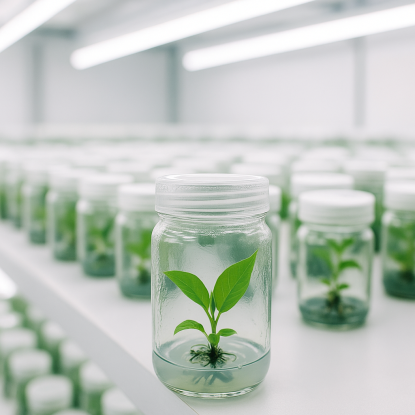
Little Sapling India® is the flagship biotechnology division of Pratyaksha Agrotech, dedicated to producing high-quality tissue culture plants at scale. With two state-of-the-art production facilities and a combined capacity of 7 million plants annually, we serve farmers, plantations, corporate sustainability projects, and global buyers.
Our specialization in bamboo tissue culture, with over 2 million plants sold every year, makes us one of India’s leading contributors to climate-focused plantation projects, agroforestry, and industrial bamboo demand.
Beyond plant production, we are pioneering AI-driven predictive modeling for carbon sequestration, enabling organizations to measure, plan, and optimize their carbon impact with unprecedented accuracy.
A Journey Rooted in Growth
What We Produce
Premium Tissue Culture Plants (7 Million Units/Year)
- High survival rates
- Uniform growth
- Disease-free propagation
- Scalable supply for large projects
Bamboo Tissue Culture Plants (2 Million Units/Year)
- Commercial & industrial bamboo varieties
- Ideal for carbon farming, agroforestry & land restoration
- Fast-growth, high biomass cultivars
- Selected for maximum carbon sequestration efficiency
Climate-Smart Varieties
- Bamboo (multiple commercial variants)
- Banana
- Areca nut
- Spices & plantation crops
- Horticulture & floriculture plants

Our Infrastructure
Farmers
Two Modern Production Facilities
- Controlled-environment labs
- Automated media preparation
- High-volume hardening units
- Trained biotechnologists & quality control teams

Quality Protocols
- Stage-wise contamination checks
- Genetic fidelity testing
- Disease indexing
- Batch traceability for every plant
Little Sapling India® is developing an advanced AI/ML framework that can:
AI for Carbon Sequestration – Our Innovation Edge
As the world changes, so must the way we grow. Pratyaksha Agrotech is deeply committed to climate-smart agriculture, helping farmers adopt practices that:
- Predict the carbon sequestration potential.
- Optimize plantation design.
- Provide project-level carbon forecasting.
- Build a digital MRV (Monitoring, Reporting, Verification) layer.